Why Germany's National Approach Weakens the Circular Economy and Burdens PET Bottles
The German government is planning a new national plastic packaging tax from 2027. Through a drafting aid attached to the 2027 Budget Accompanying Act, the national tax of 550 euros per tonne of plastic is set to apply from 1 July 2027. What is politically intended to help cover the federal budget brings tangible economic consequences for us as manufacturers and for you as fillers or buyers.
1. What Is the 2027 Plastic Packaging Tax?
The Key Points of the Draft
• Tax rate and taxable items:
Based on customs tariff numbers , the tax covers certain industrial preliminary products and semi-finished goods (sheets, plates, films, bands and strips made of PE, PP or PET plastic as well as certain cellular plastic films up to 2 mm thick), empty transport and packaging items made of plastic (including bottles , cans, bags, crates and closures) and mixed packaging with a plastic content of 5 % or more, levied on manufacturers (“winners”) or importers. The rate of €550 per tonne would be the highest in Europe.
• When the tax arises:
The tax arises as soon as the preliminary products are manufactured or “won” domestically..
• No direct recyclate exemption:
Recyclates will also be fully taxable from day one. Any relief is only to be granted retrospectively “on application”, yet the necessary ordinances and reliable certification systems are still missing.
2. What Does the Plastic Packaging Tax Specifically Mean for PET Bottles?
PET bottles today stand for a functioning circular economy with established deposit-return structures and high recycling rates. Nonetheless, the draft hits them hard:
- Significant price increases:
Rigid packaging materials such as our PET bottles could become 20 to 30 % more expensive according to the German Association for Plastics Converters (GKV), with closures rising by 30 to 50 %: verteuerna burden that is passed down the supply chain to the consumer. - No exemption for deposit and reusable systems:
The law provides no exemptions for deposit-return beverage packaging or reusable systems. Although EU-regulated and scarce recycled PET (rPET) is required for PET bottles used in food contact applications. - Unfair import loophole:
While domestic bottle manufacturers and importing fillers would have to pay the tax , already-filled packaging (for example imported beverage bottles from the EU or third countries) remains entirely tax-free. This puts the German filling and packaging industry at a massive competitive disadvantage. - Liquidity burden for mid-sized firms:
The The tax must be paid monthly in advance.For exports, refunds are only granted retrospectively on application, tying up substantial funds in SME businesses.
3. Why Industry Associations Unanimously Reject the Plastic Packaging Tax
The leading industry and business associations (including IK, GKV, BDI, HDE, BVE and other specialist bodies) unanimously reject the plastic packaging tax. The main points of criticism at a glance:
- Damage to Germany as a business location: The national special path weakens the competitiveness of domestic companies and jeopardises investment and jobs.
- Misguided ecological steering::
Instead of rewarding sustainability, the undifferentiated tax also penalises highly recyclable packaging and creates perverse incentives toward hard-to-recycle paper-plastic composites. - More, not less, bureaucracy:
Alongside the ZSVR's LUCID packaging register, a costly parallel reporting system would be created. Customs authorities would hardly be able to verify the data (mathematically, each business would be audited only once every 50 years). - Better alternative:
The associations call for the tax to be dropped and for the eco-modulation of licence fees agreed in the coalition treaty (Sections 26, 26a VerpackDG) to be implemented instead. This specifically rewards high recyclability and recyclate content and penalises hard-to-recycle formats.
4. EPROPLAST on the Plastic Packaging Tax: Promote the Circular Economy, Don't Miss the Target
As a member of the IK (German Association for Plastics Packaging and Films), we take a clear stand against the current draft.
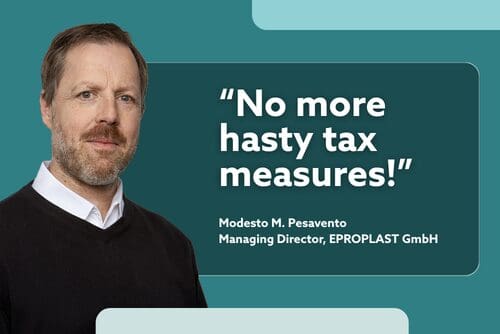
“Especially with PET bottles, we show every day how closed material cycles and high recyclate content work in practice. PET offers tangible ecological and economic advantages: low weight, lower energy input in production with lower CO2 emissions, reduced transport costs and its circularity. These advantages must not be ideologically distorted by an undifferentiated plastic tax. What should be penalised instead is more energy-intensive single-use packaging such as single-use glass. The planned plastic tax hits precisely the wrong actors: the circular-economy pioneers who have invested in closed-loop systems. What the industry needs is targeted eco-modulation that rewards genuine recycling. Not a hasty new tax.”
Modesto M. Pesavento, Managing Director, EPROPLAST GmbH
Further Reading:
- IK (German Association for Plastics Packaging and Films):
Press release: ‘The plastic tax is an act of sabotage against Germany as a business location’: - IK dedicated page with facts, charts and examples
- Joint position Statement by the Association on a plastic packaging tax dated 9 October 2026
- GKV (German Association for Plastics Converters): Press section containing statements on the plastic tax
- Negativbeispiel Spanien: The Spain cautionary tale: According to IK data, around 2,954 jobs in the plastics-converting industry were lost in the first year alone after the introduction of the Spanish plastic tax. Background and figures on the IK's dedicated page
- Federal Environment Agency, UBA Texts 87/2025: The research project expressly does not recommend an indiscriminate increase in the cost of plastic packaging.