What Changes for the Recyclability of Packaging
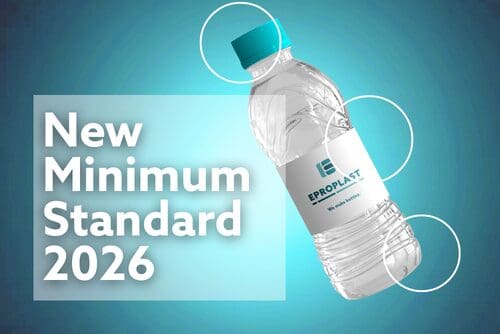
On 1 September 2026, in agreement with the German Environment Agency (UBA), the Central Agency Packaging Register (ZSVR) published the 2026 edition of the Minimum Standard for the measurement of the recyclability of packaging. It applies to packaging subject to system participation that is placed on the market from 1 January 2027 onwards.
The Essentials at a Glance
What stays the same:
- The methodology has been established since 2019 and is updated on an annual basis.
- The basis of assessment remains the actual sorting and recycling practice in Germany. in Deutschland.
- Bewertungslogik pro Produktbestandteil (Flasche, Etikett, Verschluss, Farbe) mit einem Prozentwert am Ende.
What is new:
- PFAS limit values values from Article 5 of the EU Packaging Regulation (PPWR) are removed from the assessment grid, as they have no bearing on recyclability.
- (protection of trade secrets). One example: “PE (unspecified) incl. PE-PE blends and PE copolymers with a non-polar comonomer” in Annex 2.11 (PE-flexible). Brands and manufacturers will in future have to disclose the composition of their recyclable materials in less detail. (Schutz von Geschäftsgeheimnissen). Ein Beispiel: „PE (unspezifisch) inkl. PE-PE-Blends und PE-Copolymere mit unpolarem Comonomer“ in Anhang 2.11 (PE-flexibel). Marken und Hersteller müssen künftig weniger detailliert offenlegen, wie ihre Wertstoffe zusammengesetzt sind.
- Neuer New calculation framework for the planned eco-modulation of licence fees from 2027.
Eco-Modulation from 2027: Recyclability Becomes Cost-Relevant
Under Section 26a of the German Packaging Act (VerpackG) the Federal Ministry for the Environment is set to introduce an eco-modulation of licence fees. The participation fees will then be staggered according to the degree of recyclability. Until the corresponding European rules (delegated acts under the PPWR) apply, the German ordinances rely on precisely this Minimum Standard.
Packaging with a high rating under the Minimum Standard 2026 will, in all probability, pay lower licence fees from 2027 onwards than formats that are harder to recycle.
What This Means for Your PET Bottles
For PET, sorting, washing and recycling via the German deposit-return scheme and the Yellow Bag are already so well organised that recyclable-by-design bottles generally achieve high ratings. We develop our products together with you and with all requirements in mind (from recyclability through design, functionality and market fit) into the packaging solution you need.
Decisive factors for assessments include:
- Consistent material choice without barrier layers
- Avoidance of direct printing
- Labels that separate cleanly during recycling
- Closures that match the recycling process
For more complex constructions (sleeves, barrier layers, coloured PET), a detailed review is worthwhile before the turn of the year 2026/2027.
Conclusion
The Minimum Standard 2026 represents an adjustment with planned effects on the cost side. Anyone who develops their PET packaging for high recyclability together with us secures a concrete cost advantage in licence fees from 2027 onwards.
We accompany you on the path to sustainable PET packaging and work out concrete design options with you: from material choice through labels and colour to closure mechanics.
Sources: